SEC2026-10-20 06:18:17SEC closes public comment period for crypto asset rule proposal after about 140 submissionsThe U.S. Securities and Exchange Commission is set to close the public comment period on its "Regulation Crypto Assets" proposal on Tuesday, wrapping up a 60-day review window that began after the proposal was introduced in August. During that period, the agency received about 140 comments, including six anonymous submissions. The feedback focused mainly on safe harbor provisions and exemptions for offerings below a certain amount. MiCA Crypto Alliance broadly backed the proposed changes to disclosure requirements, while also urging the SEC to define concepts and data structures specific to crypto assets more clearly. The comment process marks the latest step in the agency's review of the proposal.60
SEC2026-10-19 20:29:05SEC to Hold Roundtable on Machine-Readable Data in the Age of Superintelligence on Nov. 9The U.S. Securities and Exchange Commission said its Office of Data Standards and Innovation, part of the Division of Economic and Risk Analysis, will host a roundtable on Nov. 9, 2026. The event is titled “Machine-Readable Data in the Age of Superintelligence.” The announcement was cited by Techub News. According to the notice, the meeting is scheduled for Monday, Nov. 9. The SEC also said through its @SECGov account on X that more details about the roundtable are available through a link shared in the post. No additional agenda items or speaker details were included in the source digest. The update only states the event title, the hosting office, the date, and where readers can find more information.40
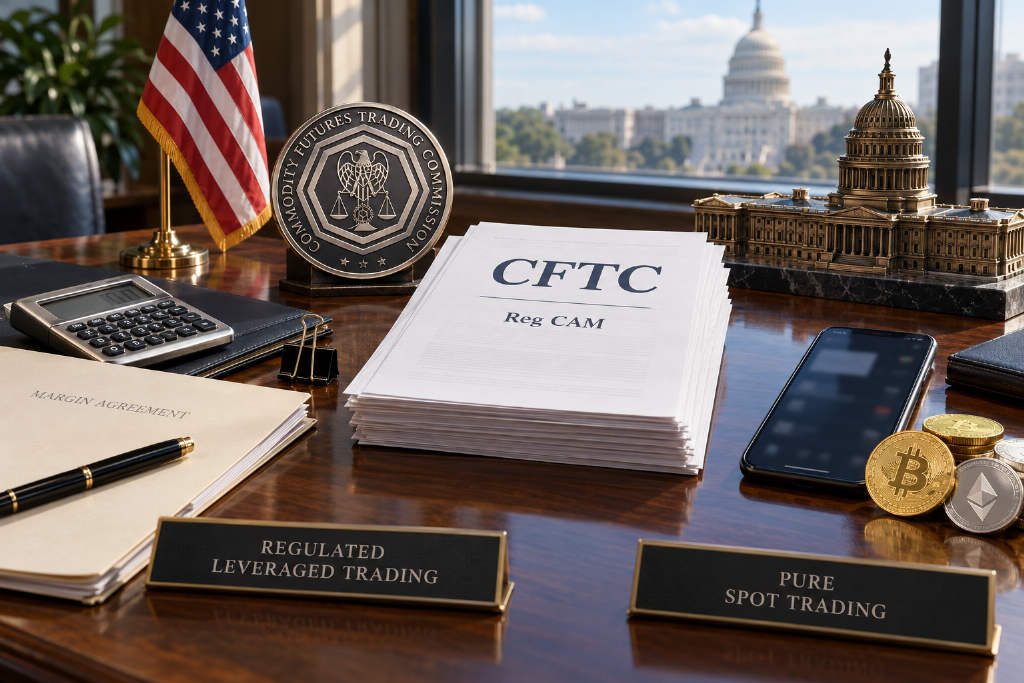
CFTC2026-10-18 23:36:10CFTC adviser says Reg CAM would offer crypto platforms an optional federal oversight pathA senior adviser to CFTC Chair Mike Selig said the agency is moving ahead with a new "Reg CAM" framework after the Clarity Act stalled, outlining an optional federal regulatory route for crypto asset trading platforms. Michael Passalacqua, who also leads the CFTC's innovation task force, said the proposal is aimed mainly at platforms serving retail customers with leveraged, margined, or financed trading. Those firms could choose to come under a CFTC-led nationwide regime instead of relying on a patchwork of state money transmitter licenses. He added that spot trading without leverage would generally remain outside this mandatory structure. Passalacqua said the goal is to put a federal path on the table, but whether the industry will view it as an attractive compliance option remains unclear. The rulemaking process is currently in the public comment stage.40
SEC2026-10-18 18:47:54Atkins says SEC will keep advancing crypto market rules after CLARITY setbackU.S. Securities and Exchange Commission Chair Paul Atkins said the agency will continue pushing for a comprehensive crypto market structure even after setbacks in Washington and changes in leadership. His remarks came after the Digital Asset Market Clarity Act failed to clear the Senate’s 60-vote procedural threshold on Sept. 15, a result that shifted attention away from near-term legislation and toward what federal regulators can do under existing authority. During Atkins’ tenure, the SEC in September announced temporary regulatory exemptions that eased some trading activity tied to tokenized stocks. The update also comes alongside a personnel change at the White House crypto committee: executive director Patrick Witt has left his post after previously taking part in negotiations over the CLARITY Act. Together, those developments show that while the legislative track has stalled, U.S. regulators are still moving on crypto oversight through agency action already available to them.50
BIS2026-10-18 13:01:04BIS paper says banks can slow stablecoin adoption by raising deposit ratesA new working paper from the Bank for International Settlements argues that banks still have a meaningful lever in the competition with stablecoins: deposit pricing. Using weekly U.S. data from January 2019 through June 2025, BIS economist Iñaki Aldasoro and Rashad Ahmed of the Andersen Institute for Finance and Economics found that stablecoin growth slowed when banks raised deposit rates. In the sample, stablecoin market capitalization typically rose about 15% over a 10-week period. A one-basis-point increase in deposit rates reduced that growth to roughly 12% in the authors’ baseline estimate, and to about 6% under a second method aimed at isolating causality. The paper also found a stronger relationship for Circle’s USDC than for Tether’s USDT, which the authors linked to USDC’s closer ties to U.S. users. The findings arrive as Washington debates whether stablecoin issuers should be allowed to pay yield and how reserve rules should be structured under the GENIUS Act.90
Telegram2026-10-17 07:02:48Court filings show Telegram shared user data with U.S. authoritiesRecently unsealed filings in a U.S. federal court show that Telegram provided certain user data to American authorities after receiving what it described as a valid legal request, according to a joint report by independent outlet Court Watch and 404 Media cited by BlockBeats on Oct. 17. The documents include a reply Telegram sent in September 2026. In that response, the company disclosed the user’s phone number, user ID, account display name, and the IP address and timestamp tied to the account’s last login. Telegram described the disclosure as voluntary while also stating that it does not concede to U.S. jurisdiction. The company said it did not provide any chat content or contact information. The report also noted that Telegram changed its policy in September 2024, allowing disclosure of IP addresses and phone numbers when judicial authorities confirm that a user is suspected of criminal activity that violates its terms of service. During 2024, Telegram responded to about 900 U.S. law enforcement requests involving 2,253 users.160
CFTC2026-10-16 15:03:57CFTC chair says agency has exclusive jurisdiction over prediction marketsMike Selig, chair of the U.S. Commodity Futures Trading Commission, said in a post on X that the CFTC has exclusive jurisdiction over prediction markets. He argued that fraud and market manipulation are not confined by state lines, making the markets a federal matter rather than one handled state by state. Selig said prediction market exchanges operate as interstate businesses by matching bids and offers from customers across the United States. He also said Congress has authorized the CFTC to apply a single set of regulatory standards to monitor and combat fraud and manipulation, while protecting customer funds involved in interstate trading. The remarks restate the agency’s position on oversight of prediction market platforms.170
Hyperliquid2026-10-16 11:00:00Hyperliquid Founder Jeff Yan Says the Goal Is Not to Replace Wall Street but to Build the AWS of FinanceHyperliquid Labs co-founder and CEO Jeff Yan used a Bloomberg Odd Lots interview on Oct. 15, 2026 to lay out the clearest public version yet of how he sees Hyperliquid: not as an on-chain version of a centralized exchange, but as a neutral protocol designed to host financial activity at scale. In the interview with Joe Weisenthal and Tracy Alloway, Yan said the market often misunderstands Hyperliquid as "on-chain Binance," when the real aim is a blockchain with a globally shared state, maintained by permissionless validators, that can support order books, liquidation systems and liquidity across many asset classes. Yan also detailed the platform’s market deployment model. To become a deployer, users must stake 500,000 HYPE tokens, not $500,000 worth of HYPE, and then win access through an on-chain Dutch auction held every 31 hours. He argued that protocol-level rules should remain mechanical rather than subjective, pointing to a hard 1% constraint between oracle price updates instead of any built-in judgment about whether a market is sufficiently liquid. On regulation, Yan said U.S. users accessing Hyperliquid derivatives through a VPN are violating the terms of service, and he argued that regulation should apply to deployers — the parties with control over market rules — rather than to the protocol itself. He also described Hyperliquid’s long-term ambition in familiar infrastructure terms: not replacing Wall Street, but becoming the AWS-like base layer on which financial systems are built.180